Caravaggio Bacchus – Painting, Meaning & Historical Context
Explore Caravaggio's Bacchus, a masterful Baroque oil painting that blends mythology, realism, and symbolism. Discover the history, patronage, and hidden meanings behind this iconic work housed in Florence's Uffizi Gallery.
Few paintings capture the tension between pleasure and mortality quite like Caravaggio’s Bacchus. This iconic oil painting transforms an ancient god into a flesh-and-blood youth, complete with dirty fingernails and overripe fruit. Understanding this masterpiece means looking beyond its surface beauty to grasp why it still provokes and fascinates viewers more than four centuries later.
Quick facts about Caravaggio’s “Bacchus”
Caravaggio’s Bacchus is an oil on canvas painted by Michelangelo Merisi da Caravaggio around 1596–1598, now housed in the Uffizi Gallery (Galleria degli Uffizi) in Florence, Italy. The painting measures approximately 95 × 85 cm (37 × 33 inches).
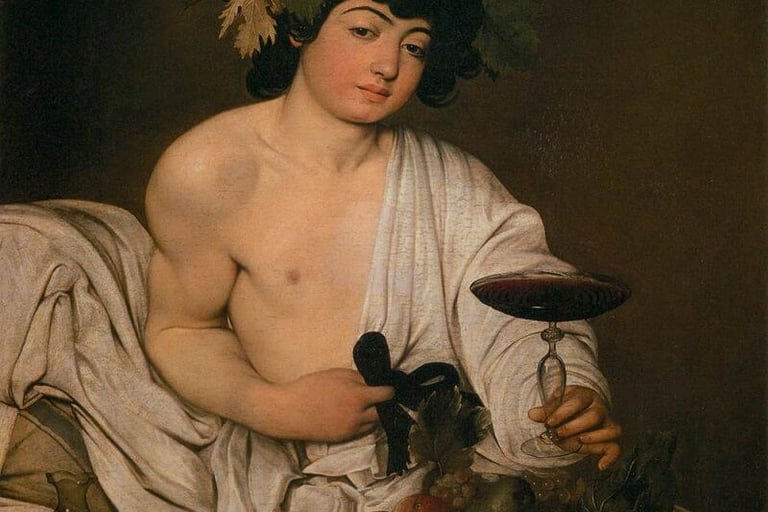
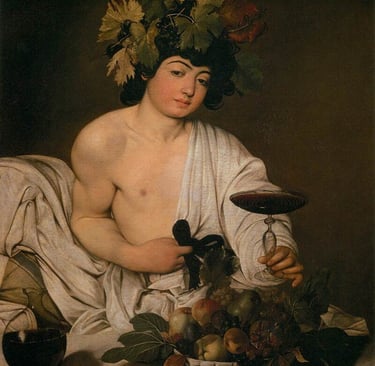
The artwork depicts a young man dressed in the style of the Roman god of wine, reclining while offering a shallow goblet of red wine directly to the viewer. A stone table beside him holds a basket overflowing with grapes and other fruit, alongside a large carafe of wine.
Key details at a glance:
Artist: Michelangelo Merisi da Caravaggio
Date: c. 1596–1598
Medium: Oil on canvas
Dimensions: 95 × 85 cm / 37 × 33 in
Location: Galleria degli Uffizi, Florence
Patron: Cardinal Francesco Maria del Monte
Subject: Bacchus (Dionysus), god of wine
Central themes running through the work include sensuality, vanitas symbolism, uncompromising realism, and hidden elements that reward close examination—including what may be a self portrait concealed within the glass.
Visual description of the painting
The composition emerges from a dark, neutral background characteristic of Caravaggio’s early Roman works. Strong light rakes in from the left, sculpting the figure and still life elements while compressing the space into an intimate encounter between painting and viewer.
Bacchus reclines on what appears to be a heavy mattress or couch, his upper body twisted toward us in a pose echoing classical antiquity. His left hand extends forward, holding a shallow goblet of red wine—the liquid surface shows visible ripples, as if freshly poured. The invitation could not be more direct.
The youth’s face appears slightly flushed, framed by thick dark curls beneath a crown of vine leaves and grape clusters. His bare torso is partially wrapped in off-white drapery that pools in tangled folds, imitating ancient Roman statuary. Yet Caravaggio inserts jarring details: the fingernails are visibly dirty, the skin shows a workman’s tan rather than aristocratic pallor.
On the stone table, a woven basket overflows with autumn harvest—ripe grapes, split pomegranates, apples, and figs. But look closer and you notice bruised skins, yellowed leaves, and spots of decay. A glass carafe nearby captures intricate light reflections on the wine within, demonstrating Caravaggio’s technical virtuosity.
Historical context and commission
Rome in the mid-1590s was a hub of artistic ferment during the Counter-Reformation. The young painter from Milan arrived in the city around 1592–1594, initially struggling to find his footing. He worked briefly for Giuseppe Cesari (known as Cavalier d’Arpino) before circumstances changed dramatically.
Around 1595, Cardinal Francesco Maria del Monte purchased Caravaggio’s “Boy with a Basket of Fruit” and brought the artist into his household. Del Monte became Caravaggio’s first important patron, providing living quarters at the Palazzo Madama and steady commissions. The cardinal’s educated circle valued music, science, alchemy, and classical mythology—interests reflected in the sophisticated secular subjects Caravaggio painted shortly after joining the household.
Bacchus was created during this period of early success, likely between 1596 and 1598. Whether commissioned specifically by del Monte or created as a personal work that caught the cardinal’s attention remains uncertain. What’s clear is that it remained in del Monte’s collection for roughly a decade.
The painting’s journey to Florence came through political gift-giving. Around 1608, as Caravaggio fled Rome following his 1606 killing of Ranuccio Tomassoni, del Monte sent Bacchus along with the famous Medusa shield to Ferdinando I de Medici, Grand Duke of Tuscany, to celebrate the wedding of Cosimo II de Medici.
For centuries afterward, the picture languished in relative obscurity. Only during inventory and restoration efforts around 1913–1916 did staff discover it in Uffizi storerooms. Cleaning revealed underpaint layers that confirmed Caravaggio’s authorship, transforming a forgotten canvas into a recognized masterpiece.
Patronage, model and possible self-portrait
Cardinal del Monte’s household provided Caravaggio with more than financial security. The patron’s cultivated environment offered access to models, props, and the intellectual freedom to explore subjects that balanced classical learning with the artist’s radical naturalism.
The prevailing scholarly hypothesis identifies the model as Mario Minniti, a young Sicilian painter who became Caravaggio’s close companion in Rome. Minniti’s androgynous features and lithe build appear in several early works, including Boy Bitten by a Lizard and The Fortune Teller. His street-youth appearance suited Caravaggio’s vision of gods and mythological figures as recognizable Roman types rather than idealized abstractions.
An alternative theory, advanced by Caravaggio’s contemporary rival Giovanni Baglione in his 1642 biography, suggests the painting may incorporate a self portrait. Baglione criticized Caravaggio for his supposed inability to paint from imagination, writing that he “could not work without nature present.” This was intended as an insult, revealing the competitive tensions of Baroque Rome’s art historian circles.
Technical studies have added an intriguing detail to this debate. Radiographic analysis of the glass carafe revealed a tiny reflected silhouette—possibly showing a figure holding a brush or tool. Some interpret this as Caravaggio’s hidden signature, a reflection of the artist at work captured within his own creation.
The painting also carries subtle homoerotic undertones through its sensual pose, inviting gaze, and exposed flesh. These elements likely reflected the tastes within del Monte’s all-male artistic circle, though interpretations should avoid oversimplification.
Meaning, symbolism and Vanitas themes
Bacchus blends mythological subject matter with moral and symbolic layers typical of late 16th-century Italy. The god of wine, ecstasy, and fertility traditionally represented liberation from everyday constraints. Yet Caravaggio’s youthful, almost adolescent depiction emphasizes temptation and sensuality over divine power.
The fruit basket functions as a concentrated vanitas allegory. Amid ripe grapes and pomegranates, viewers find bruised skins, wormholes in apples, moldy figs, and wilting leaves. These aren’t artistic failures—they’re deliberate memento mori symbols. Time passes. Flesh decays. Beauty fades.
The same wine that promises pleasure also marks the passage of time toward inevitable corruption.
The extended goblet creates a direct relationship with anyone standing before the canvas. Bacchus doesn’t merely display wine—he offers it. The viewer becomes implicated in the choice between indulgence and restraint, a tension that would have resonated powerfully in Counter-Reformation Rome where sacred and profane pleasures existed in constant friction.
Contrast operates throughout the image. Luxurious elements like fine glassware and abundant harvest sit alongside imperfections: those dirty fingernails, the spirit of decay among the fruit. This juxtaposition comments on the fragility of youth and beauty, suggesting that even at the peak of ripeness, corruption has already begun.
Some art historian interpretations read the work as an allegory of life’s brevity, while others see coded messages about earthly versus spiritual pleasures. What remains constant across readings is Caravaggio’s refusal to offer simple moral answers. He presents the question and leaves viewers to wrestle with their own responses.
Style, technique and Caravaggio’s realism
Bacchus represents a decisive break from the idealized classicism that dominated Renaissance depiction of mythological subjects. Where earlier painters like Titian portrayed gods with polished perfection, Caravaggio confronted viewers with someone who looked like he might have been picked up from a Roman tavern that morning.
The artist worked directly on canvas without detailed preparatory drawing, a technique called alla prima that allowed for spontaneous revisions. X-radiography studies reveal pentimenti—visible changes—in the positioning of the hand and arrangement of drapery. Caravaggio thought through problems on the canvas itself rather than resolving everything in advance.
His proto-tenebrism, the dramatic contrast between illuminated forms and deep shadow, creates the distinctive atmosphere. Strong light from the left models the figure with almost sculptural precision while the neutral background compresses space. Bacchus seems to exist in a shallow zone just beyond the picture plane, close enough to touch.
Naturalistic details accumulate throughout. Hair shows individual texture rather than stylized patterns. Skin tones include visible imperfections and the flush of wine. The glass carafe captures light reflections with scientific precision. The fruit surfaces display tactile variety from smooth grape skins to the rough texture of fig leaves.
This approach to baroque art proved revolutionary. By making mythology recognizable and physical, Caravaggio transformed how painters understood the relationship between ancient subjects and contemporary observation.
“Young Sick Bacchus” and related works
Before the Uffizi canvas, Caravaggio explored the Bacchus theme in a work now known as the Young Sick Bacchus or Bacchino Malato. Painted around 1593–1594 and currently in the Galleria Borghese in Rome, this earlier oil painting offers a striking contrast.
The Borghese picture is widely considered a self portrait created during Caravaggio’s recovery from serious illness—possibly malaria contracted in Rome’s swampy environment. The figure’s pallid, greenish-yellow skin and withdrawn expression suggest physical frailty rather than seductive invitation. Where the later Bacchus offers wine with confident sensuality, the sick Bacchus barely manages to hold his grapes.
Both paintings share formal elements: dark background, three-quarter pose, crown of vine leaves, still life components. But the emotional content differs dramatically. One depicts a god weakened by mortality; the other presents temptation at its most alluring.
Caravaggio’s recurring interest in Bacchus imagery connects to broader explorations in works like Boy with a Basket of Fruit, which anticipates the sophisticated still life of the mature painting. These early Roman works established patterns—the use of recognizable street youth as models, the integration of portraiture with genre elements—that would define his revolutionary approach to history painting.
Legacy and why Caravaggio’s “Bacchus” matters today
Caravaggio’s Bacchus stands as one of the most important secular works in baroque art, demonstrating how a single canvas could integrate still life, portraiture, and mythology into something unprecedented. The painting challenged contemporary assumptions about how ancient subjects should appear, opening doors that later artists rushed through.
The influence spread across Europe as painters adopted Caravaggio’s realism, dramatic lighting, and willingness to use everyday models for sacred and mythological subjects. From Artemisia Gentileschi to the Utrecht Caravaggisti, his approach reshaped artistic possibilities for generations.
Today the painting draws multitudes to the Uffizi Gallery annually. It appears in discussions of queer readings in art history, vanitas symbolism, and the complicated relationship between artists and self-representation. The questions it poses—about temptation, mortality, beauty, decay—lose none of their urgency across centuries.
What makes Bacchus endure is its refusal to resolve into a single meaning. The image seduces while it warns. It celebrates youth while documenting corruption. Ancient myth filters through the grit of 16th-century Rome, and the result still challenges anyone who meets that steady gaze.
If you find yourself in Florence, the painting waits in the Uffizi, goblet extended, offering the same wine it has offered since Caravaggio first lifted his brush. The choice of whether to drink remains yours.

100% Secure Booking - Official 2026 Ticket Links | 233 Steps to the View - Climb the iconic Arnolfo Tower | 725 Years of History - From Medieval Fortress to Ducal Palace
© PalazzoVecchioFlorence.com 2026 - All rights reserved. Privacy Policy. Affiliate disclosure.
This is not an official website. This is independent ticket reseller site is offering links to official authorized ticket resellers and might earn commission on tickets.